
What is Chitosan?
Chitosan is a versatile, non-toxic, and biodegradable polysaccharide derived from chitin—the second most abundant natural polymer on Earth after cellulose. It serves the same solidifying function as cellulose as a major component of the shells of crustaceans and insects, and in the cell walls of mushrooms. Like cellulose, it is insoluble, which limits its use.
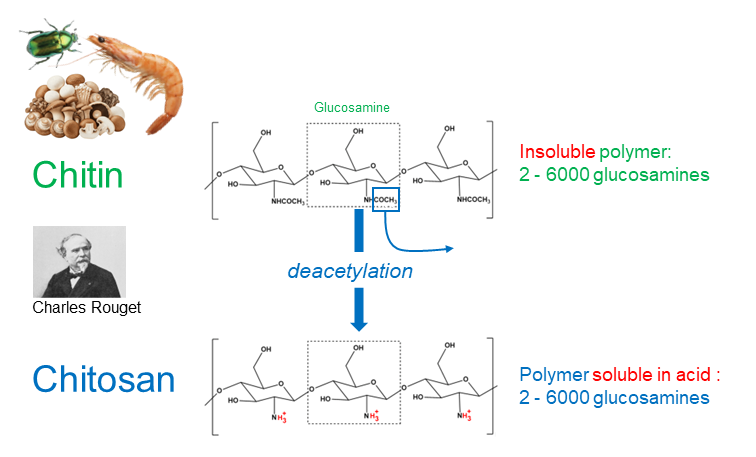
The history of chitosan dates back to 1859, when French researcher Charles Rouget heated chitin in an alkaline solution, discovering a modified compound that tuned out to be soluble in acid solutions. In 1894, German chemist Felix Hoppe-Seyler officially named this derivative “chitosan.”
Rouget’s reaction is a deacetylation that removes acetyl groups to expose reactive, positively charged amino groups . This makes chitosan adherent and biologically active:
Chitosan is utilized across many industries, including:
- Water Treatment: it acts as a flocculant to remove heavy metals, oils, and particulate matter.
- Biomedicine & Pharmaceuticals: it is used to stop bleeding, accedlerate healing and control the release of drugs.
- Food & Cosmetics: it is used as a preservative, packaging film, and moisturizing agent.
Chitosan in Agriculture
Chitosan is one of the most promising bio-based molecules in agriculture., used across the world. In the European Union, it is approved as a Basic Substance under Regulation (EC) No 1107/2009 as an elicitor of plant self-defence mechanisms.
Chitosan has multiple biological activities:
- Antimicrobial and biopesticide: it displays direct broad-spectrum antimicrobial activity against fungi, bacteria, and viruses, suppressing pathogens without leaving toxic chemical residues.
- As a biostimulant:
– It enhances photosynthesis and increases nutrient uptake.
– It elicits defense mechanisms against biotic stress (pathogens).
– It elicits defense mechanisms against abiotic stress (drought, heat. cold, salinity). - As a soil enhancer: When applied to soil, chitosan stimulates beneficial microbial populations and micronutrients, keeping them available for root uptake.
The main types of chitosans
Chitosans vary by molecular weight, chain length, and the degree of deacetylation ( making them more or less charged), each serving specialized functions in crop management:
- Linear Chitosans: Standard medium-to-high molecular weight polymer chains can invisible, protective semi-permeable films over plant leaves and fruit surfaces. This physical barrier acts as an anti-transpirant (reducing water loss) while blocking fungal spores and bacteria from colonizing plant tissues.
- Chitosan Oligosaccharides (COS): Depolymerized, low molecular weight short chains that are easily absorbed through plant cuticles and stomata. COS acts as a fast-acting systemic signal to trigger internal plant defense pathways.
- Chitosan Nanoparticles: Chemically-modified chitosans with high surface area for better contact and penetration Chitosan nanoparticles can carry active ingredients, offering sustained release, systemic delivery, protection and biological activity at significantly lower dose rates.