
The gap between laboratory promise and agronomical reality stems from fundamental structural challenges:
- Polymer Heterogeneity: Chitosan is not s single molecule of a well defined size. It is a polymer, a linear chain of a variable number of sugar monomers, glucosamines. The number of glucosamines can vary from a few dozen for chitosan oligosaccharides to over 5000 for high molecular weight variants:
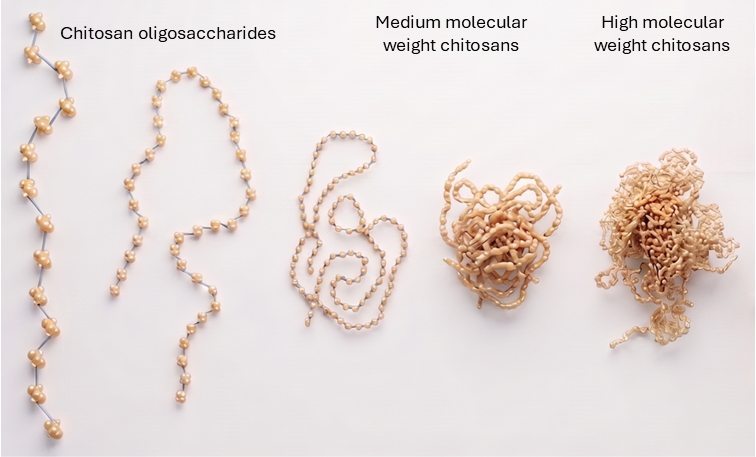
- For any chitosan batch, depending on the source and the manufacturing methods, the distribution of sizes and chemical properties can vary greatly. And this leads to variations in agronomic performance.
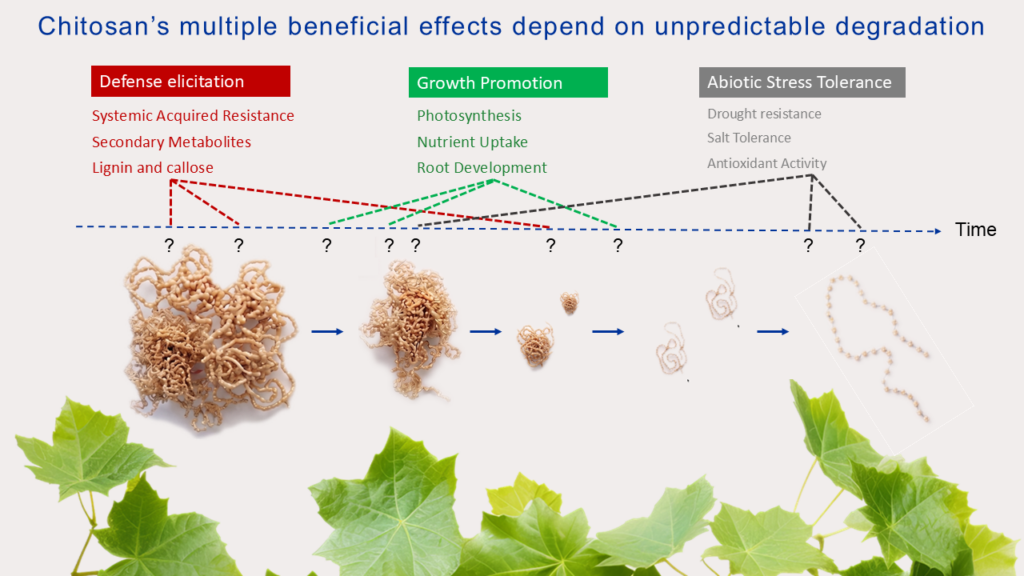
- Chitosans of different sizes act differently: Biostimulation is a general term that encompasses elicitation of plant defenses (disease resistance), increase in metabolism (biomass) and in abiotic stress tolerance (drought, heat, soil salinity). Depending on the size and chemistry of any given chitosan molecule, a different type of plant response occurs.
- Rapid degradation: Even if it were possible to produce uniformly sized chitosans, smaller fragments would be generated rapidly and unpredictably : sugar polymers are very fragile . Many microorganisms have enzymes that can digest chitosan before it manages to reach plant receptors. This explains the variability observed with chitosans: sometimes they work well, sometimes they fail.
……. …..
- Chemical instability and pH sensitivity: Chitosan is only soluble and active as a direct antimicrobial agent at least at slightly acid pH. In soils that are neutral or basic, chitosan, especially of large molecular weight, will be inactive.